

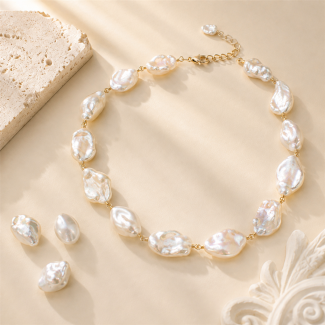
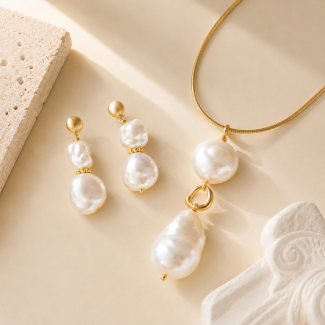
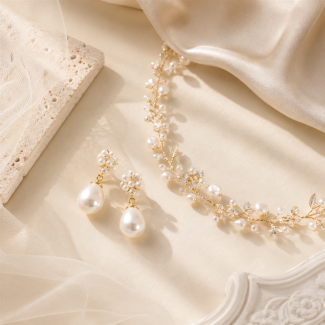
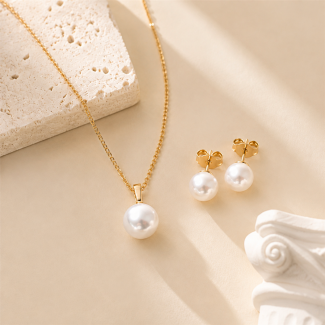
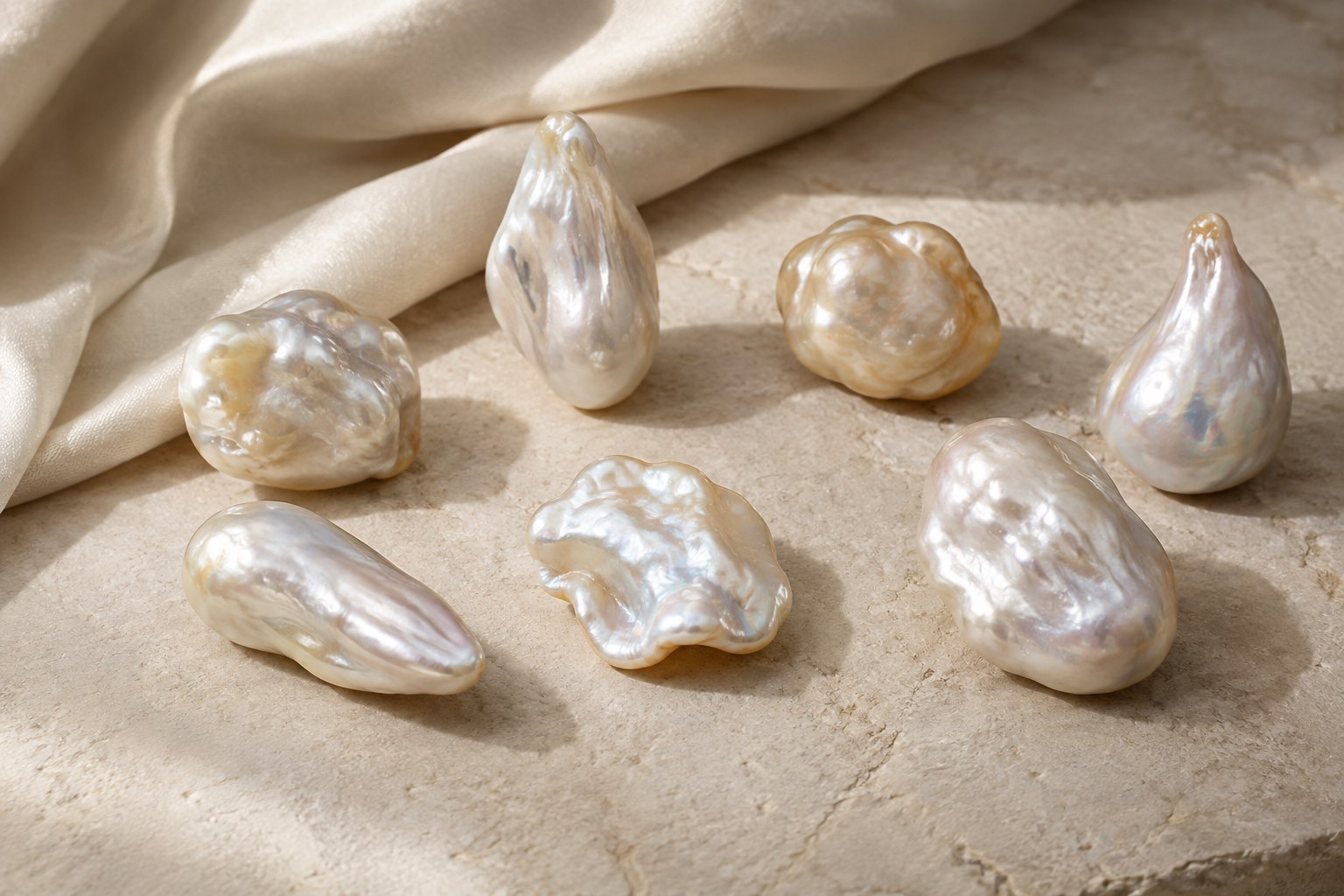
Baroque pearls are pearls with irregular, non-spherical shapes. They may be softly asymmetrical, curved, ridged, elongated or entirely free-form. “Baroque” describes a pearl’s shape—not whether it is real, where it grew or how good its quality is.
Some baroque pearls are only gently asymmetrical; others have deep ridges or dramatic contours. The term covers a wide range, so photographs and measurements are often more useful than the label alone.
What does “baroque” mean in pearls?
Pearl shapes are often grouped into broad families: spherical, symmetrical and baroque. Round and near-round pearls belong to the spherical family. Oval, button and drop shapes can be symmetrical even though they are not round. Baroque pearls do not have a regular axis of symmetry and are defined by their individual outlines.
In everyday jewelry language, “baroque” is sometimes used loosely for almost any pearl that is not perfectly round. GIA’s shape terminology is more precise: a semi-baroque pearl is off-round or only slightly irregular, while a baroque pearl has no apparent symmetry. A balanced oval, button or drop pearl may be non-round yet still belong to the symmetrical family.
How do baroque pearl shapes form?
Pearls grow inside mollusks as layers of pearl material build around a developing centre. If those layers accumulate unevenly, if the pearl shifts as it grows, or if the pearl sac itself has an irregular form, the result may be baroque.
The finished outline can also be influenced by the mollusk species, cultivation method, growth time and conditions inside the mollusk. The process is biological, so even carefully managed cultivation cannot produce a perfectly predictable result.
The resulting ridges, curves and changes of plane record how the pearl developed. They can be visually appealing, but shape should still be assessed together with lustre, surface condition and durability.
Are baroque pearls freshwater or saltwater?
They can be either. Baroque is a shape category, not a pearl type.
- Freshwater cultured pearls are especially well known for a wide range of baroque forms, colours and sizes.
- South Sea and Tahitian cultured pearls can also grow in dramatic baroque shapes.
- Akoya cultured pearls are often selected for roundness, but irregular Akoya pearls can occur as well.
To understand the material behind many contemporary baroque designs, read our guide to what freshwater pearls are.
What are the common baroque silhouettes?
There is no single baroque outline. Descriptive names can vary between sellers, but these visual families are useful when comparing pieces:
- Organic oval: elongated, but with an uneven or shifting outline.
- Free-form drop: narrower at one end without the balanced symmetry of a classic drop.
- Coin-like or flattened: broad and relatively flat, often with an irregular edge.
- Stick or elongated: long, narrow forms with ridges or bends.
- Petal-like: thin, broad forms that may resemble a petal or small leaf.
- Circled: one or more visible rings or grooves wrap around the pearl; circled pearls may also be baroque.
- Highly sculptural: complex, free-form pearls that do not fit a simple geometric description.
For the wider shape system, see our guide to round, oval, drop, button, circled and baroque pearls.
Are baroque pearls real?
Yes—baroque pearls can be real natural or cultured pearls. Their irregularity does not make them fake, just as perfect roundness does not by itself prove authenticity.
Imitation pearls can also be manufactured in irregular shapes, so shape alone cannot identify a pearl. Look for a clear material description stating whether the pearl is natural, cultured or imitation. Most real pearls used in modern jewelry are cultured.
If a listing says only “baroque pearl” without identifying whether it is cultured or imitation, ask for clarification. Good material language helps you understand what you are buying without relying on romantic but vague terms.
Are baroque pearls less valuable than round pearls?
Not automatically. Perfectly round pearls are rare and often command higher prices when other quality factors are equal, but shape is only one part of value. A baroque pearl with beautiful lustre, an appealing silhouette, good surface condition and unusual colour can be highly desirable.
Consider the complete pearl:
- Lustre: Does the surface reflect light with brightness and depth?
- Shape: Is the form attractive and useful for the intended design?
- Surface: Do natural features enhance the character, or are there cracks and damage that affect durability?
- Colour: Are the body colour and overtones lively and pleasing?
- Nacre quality: Does the surface look coherent and well formed?
- Size: Is the scale unusual for its pearl type and quality?
- Design and matching: Has the maker used the individual form thoughtfully?
A pleasing baroque shape can be rare in its own way. Value comes from the combination of the pearl’s qualities, the materials around it and the craftsmanship of the finished piece.
Natural variation or damage?
Irregular shape, gentle ridges and small surface variations can be part of a pearl’s natural growth. Damage is different. Deep cracks, peeling layers, heavy abrasion or a broken area around a drill hole may affect durability and should not be presented simply as “organic character.”
Examine the whole piece in good light. In a thoughtful design, the pearl’s natural features should feel intentional, the drill hole should be clean, and the setting or stringing should support the pearl securely. You can also explore why natural pearl variation occurs.
Why do jewelry makers choose baroque pearls?
Baroque pearls often require the maker to respond to the shape already present. A flatter side may determine how a pendant faces, while a curve or ridge can influence wire placement and the way the pearl catches the light.
For earrings, the goal may be balance rather than exact duplication. Two pearls can differ in outline yet still work as a pair when their size, colour, lustre and visual weight are compatible.
How to choose baroque pearl jewelry
- Look from more than one angle. A baroque pearl changes as it turns, so front-only photos may not show the full shape.
- Prioritise lustre. A lively surface brings depth to an irregular form.
- Check the pair or group as a composition. Matching can mean harmony rather than exact duplication.
- Read the measurements. Baroque pearls may be measured across more than one dimension because they are not round.
- Review material disclosures. Confirm whether the pearls are cultured and whether colour treatments are disclosed.
- Inspect the construction. Drill holes, wirework, settings and stringing should suit the pearl’s shape and weight.
If you prefer understated jewelry, choose compact baroque pearls with gentle asymmetry. For a stronger focal point, look for elongated or highly sculptural forms. There is no single “correct” baroque shape; the best choice is the one whose character feels deliberate in the design.
How are baroque pearls measured?
A round pearl can usually be described with one diameter. A baroque pearl often needs two or three measurements—such as length, width and depth—to communicate its scale accurately. When comparing jewelry online, look for measurements in millimetres and photographs from more than one angle. A single number may not capture how large or dimensional an irregular pearl appears when worn.
How to care for baroque pearls
Baroque pearls need the same gentle care as other pearl shapes. Put them on after perfume, hairspray and cosmetics have dried. Wipe them with a clean, soft cloth after wear, and store them separately from harder jewelry that could scratch the surface.
Irregular outlines can have raised areas that receive more contact, so avoid rubbing or polishing aggressively. Never use steam or an ultrasonic cleaner. If a piece combines pearls with gemstones, plated metal, adhesive or silk thread, choose a cleaning method safe for every material in the design.
For a complete routine, see how to care for pearl jewelry and our step-by-step guide to cleaning pearls safely.
Discover more about pearl types, shapes and individuality in our broader pearl guide.
Frequently asked questions
Is every irregular pearl baroque?
Not necessarily. Oval, button and drop pearls may be symmetrical shapes even when they are not round. “Baroque” is most useful for pearls with clearly irregular, non-symmetrical forms.
Are baroque pearls lower quality?
No. Shape is one quality factor among several. A baroque pearl can have excellent lustre, colour and nacre quality, while a round pearl can have dull lustre or surface damage.
Can baroque pearls be matched for earrings?
Yes. A pair can be matched closely, or balanced more expressively through similar size, colour, lustre and visual weight while keeping different outlines.
Why are freshwater baroque pearls so varied?
Freshwater cultivation methods and the biology of freshwater mussels can produce a broad range of forms. Their extensive nacre and varied growth patterns give designers many silhouettes to work with.
Do baroque pearls need special storage?
Store them in a soft pouch or lined compartment, separate from harder jewelry. Lay strung pieces flat, and avoid pressure on pronounced ridges or delicate settings.